Artificial Intelligence in Science: From Molecular Prediction to Experimental Discovery
Explore how artificial intelligence is transforming scientific research through protein structure prediction, molecular design, biomedical imaging, biological data analysis and experimental discovery.
Scientific discovery has traditionally depended on the ability of researchers to observe natural phenomena, formulate hypotheses and evaluate experimental evidence. Artificial intelligence introduces a complementary dimension to this process by enabling computational systems to investigate relationships within complex scientific information, generate molecular predictions and assist in identifying new research directions.
The significance of artificial intelligence in science extends beyond computational efficiency. It is transforming the relationship between biological knowledge, experimental investigation and technological innovation. From predicting protein structures to interpreting microscopic images, AI provides new ways of exploring scientific questions that were previously difficult to investigate at scale.
Understanding this transformation begins with the fundamental principles of scientific learning and progresses toward the integration of computational intelligence with modern experimental biotechnology.
1. Artificial Intelligence as a New Scientific Instrument
Throughout scientific history, instruments have expanded the boundaries of human observation. Microscopes revealed cellular structures, sequencing technologies exposed the molecular organization of genetic information, and advanced spectroscopic methods enabled researchers to characterize biological molecules.
Artificial intelligence represents a different type of scientific instrument. Rather than directly measuring physical or biological phenomena, computational models analyze information obtained through observations, experiments and existing scientific datasets.
Machine learning, a major component of artificial intelligence, involves computational methods that learn relationships from data. A model can be trained using examples containing measurable characteristics and, depending on its purpose, associated experimental outcomes. The resulting computational representation may then be used to investigate previously unseen information.
For example, a researcher studying cellular responses to experimental treatments may generate thousands of microscopic images. Conventional manual examination can provide valuable biological insights, but the volume of information may make comprehensive evaluation difficult. Machine learning can assist in identifying cells, measuring morphological characteristics and recognizing patterns associated with different experimental conditions.
The computational model does not independently determine the biological significance of these patterns. Scientific interpretation still requires knowledge of the experimental system, appropriate controls and consideration of alternative explanations.
Artificial intelligence transforms scientific information into computational predictions or representations. Experimental science determines whether those representations correspond to meaningful physical or biological phenomena.
This distinction between prediction and observation is central to understanding how artificial intelligence contributes to molecular biology and biotechnology.
2. How Machine Learning Interprets Scientific Information
Scientific datasets contain information about biological structures, molecular interactions, cellular characteristics and experimental outcomes. However, the relationships between these observations are often complex and may involve many interacting variables.
Machine learning provides computational approaches for investigating such relationships. Different learning strategies are appropriate for different scientific objectives, depending on the nature of the available information and the intended analytical task.
Supervised learning uses examples associated with known outcomes or annotations. In biomedical imaging, for instance, annotated images can help a model learn to distinguish cellular structures from surrounding regions. Unsupervised learning instead investigates patterns without requiring predefined outcome labels, making it useful for exploring molecular variation and biological heterogeneity.
Generative models extend these capabilities by learning representations of existing data that can support the generation of new examples. In molecular research, such models may contribute to the design of candidate structures with selected characteristics.
| Learning approach | Fundamental principle | Scientific application |
|---|---|---|
| Supervised learning | Learning from annotated examples | Image classification and outcome prediction |
| Unsupervised learning | Identifying structure within unlabeled information | Cellular clustering and molecular data exploration |
| Self-supervised learning | Learning representations using signals derived from the data | Protein and biological sequence modeling |
| Generative modeling | Generating new candidates from learned data representations | Molecular and protein design |
Table 1. Representative machine learning approaches and their applications in scientific research. These approaches can overlap within a single model.
The reliability of these methods depends on the quality and representativeness of the information used during model development. If experimental datasets contain systematic biases, inconsistent annotations or incomplete measurements, the computational model may learn relationships that do not generalize to new biological conditions.
One of the clearest demonstrations of how machine learning can contribute to fundamental biological understanding is the investigation of protein structure.
3. Protein Structure Prediction: Connecting Sequence to Biological Architecture
Proteins are essential components of living systems. They participate in cellular communication, molecular transport, biochemical reactions, structural organization and the regulation of biological processes.
A protein consists of amino acids arranged in a specific sequence. Under appropriate conditions, interactions between these amino acids and their surrounding environment contribute to the formation of three-dimensional structures. These structures influence the ability of proteins to interact with other molecules and perform biological functions.
Determining how a protein sequence relates to its three-dimensional structure has been a major challenge in structural biology. Experimental techniques such as X-ray crystallography, nuclear magnetic resonance spectroscopy and cryo-electron microscopy provide structural information, although their suitability depends on the properties of the biological system.
In 2021, Jumper and colleagues published the redesigned AlphaFold system in Nature. Its performance during CASP14 demonstrated that machine learning could generate highly accurate structural predictions for many protein targets included in the assessment.
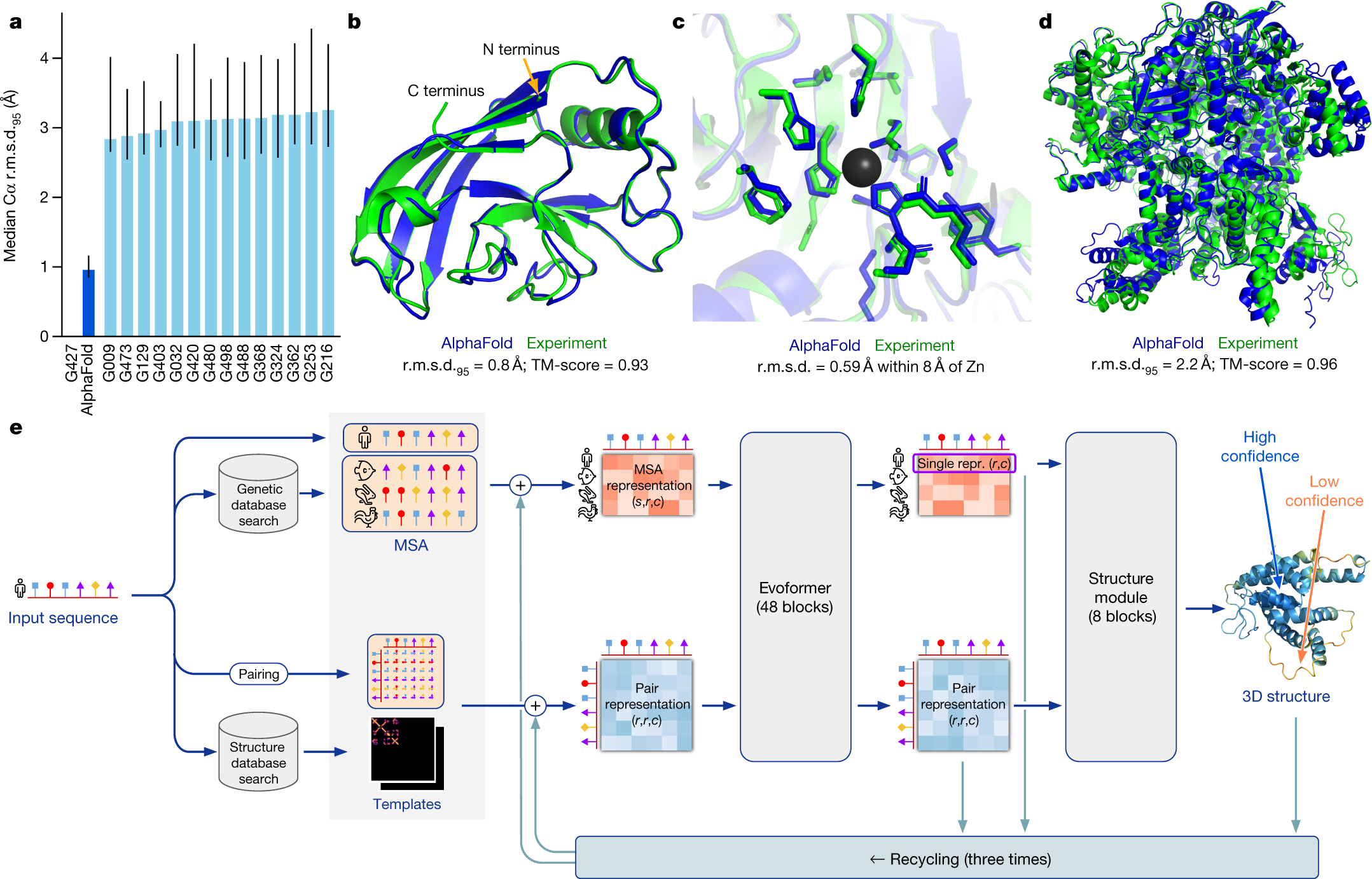
Source: Jumper et al., Nature 596, 583–589 (2021), original Figure 1. Original figure, unmodified. CC BY 4.0.
The biological importance of structural prediction can be illustrated through the investigation of protein variants. If a genetic change alters an amino acid within a protein, a predicted structure may help researchers assess its location relative to known functional regions or molecular interfaces.
However, structural predictions do not necessarily reveal how proteins behave under every physiological condition. Proteins can adopt different conformations, interact with other molecules and respond dynamically to environmental changes.
The relationship between predicted structure and biological function therefore remains an experimental question. Structural prediction is valuable because it provides a foundation for investigation rather than a complete explanation of molecular behavior.
Once computational systems can predict structures from biological information, a complementary scientific question emerges: can artificial intelligence help design structures that do not already exist in nature?
4. Generative Artificial Intelligence and the Design of New Proteins
Conventional protein research often begins with a biological molecule already present in nature. Researchers investigate its structure, interactions and functional characteristics to determine how it contributes to biological processes.
Protein engineering extends this approach by introducing selected modifications into existing proteins or developing new protein architectures intended to produce particular molecular properties.
Generative artificial intelligence contributes to protein engineering by supporting the computational exploration of possible molecular structures. Instead of evaluating only naturally occurring proteins, researchers can investigate candidates generated within a computational design space.
RFdiffusion, described by Watson and colleagues in 2023, demonstrated how a diffusion-based generative model could support the design of protein structures under different structural constraints.

Source: Watson et al., Nature 620, 1089–1100 (2023), original Figure 1. Original figure, unmodified. CC BY 4.0.
The distinction between molecular prediction and molecular design is scientifically important. Prediction seeks to characterize the properties or architecture of an existing biological sequence. Design seeks candidates that may satisfy selected structural or functional objectives.
| Characteristic | Structure prediction | Generative design |
|---|---|---|
| Scientific objective | Understand molecular architecture | Explore new molecular architectures |
| Representative input | Existing biological sequence | Structural or design constraints |
| Computational output | Predicted molecular structure | Candidate molecular design |
| Example application | Structural characterization | Protein engineering research |
| Experimental requirement | Structural and functional validation | Production and functional characterization |
Table 2. Complementary roles of molecular prediction and generative design in structural biotechnology.
Potential biotechnology applications include the investigation of new protein-based materials, molecular recognition systems and research reagents. A computationally generated candidate must nevertheless be characterized to determine whether it can be produced, remains stable and exhibits the intended properties.
Generative models therefore establish a connection between computational exploration and experimental molecular engineering. This connection is also central to another major area of artificial intelligence: the discovery and evaluation of candidate therapeutic molecules.
5. Artificial Intelligence in Molecular Screening and Drug Discovery
Drug discovery is a multidisciplinary process involving the identification of relevant biological mechanisms, the investigation of molecular interactions and the evaluation of candidate compounds.
The chemical space of potentially relevant molecules is extremely large. Experimentally evaluating every possible candidate is generally impractical, creating a need for approaches that help researchers prioritize molecules for further investigation.
Machine learning can contribute to this process by analyzing relationships between chemical structures, molecular descriptors and available experimental measurements. Computational predictions may assist in identifying candidates associated with particular biological properties.
A representative scientific example was published by Stokes and colleagues in Cell in 2020. The researchers combined machine learning with experimental screening to identify halicin as a compound exhibiting antibacterial activity. The study demonstrated the potential of computational prioritization to complement experimental discovery.
The scientific significance of this example is not that artificial intelligence independently developed a clinically established medicine. Rather, it helped identify a research candidate that could be investigated through biological experiments.
Computational predictions become scientific discoveries when they are supported by appropriate experimental evidence.
Reference: Stokes et al. A Deep Learning Approach to Antibiotic Discovery. Cell (2020).
Computational molecular screening may also support investigations of molecular binding, physicochemical properties and biological activity. These predictions represent different scientific questions and must not be treated as interchangeable measures of therapeutic suitability.
A molecule predicted to interact with a biological target may fail to produce the expected cellular response. Similarly, activity observed under experimental conditions does not establish clinical safety or efficacy.
Understanding these differences requires researchers to examine molecular activity within increasingly complex biological systems. Artificial intelligence can assist in interpreting those systems through the analysis of experimental images.
6. Biomedical Imaging and Intelligent Analysis of Cellular Systems
Microscopy provides direct access to the structural organization of biological systems. Through imaging, researchers can investigate cell morphology, tissue architecture, intracellular structures and biological responses to experimental conditions.
Modern imaging technologies can generate extensive collections of high-resolution images. While these datasets contain valuable biological information, extracting quantitative measurements may require the identification of individual cells, their boundaries and relevant intracellular regions.
Image segmentation is the computational process of assigning regions of an image to identifiable objects or biological structures. In cellular imaging, segmentation can help distinguish individual cells and support subsequent quantitative analysis.
Cellpose is a deep-learning-based approach developed for cellular image segmentation. In 2022, Stringer and Pachitariu described Cellpose 2.0, extending the framework to support adaptation of segmentation models to particular imaging datasets and research requirements.

Source: Stringer and Pachitariu, Nature Methods 19, 1634–1641 (2022), original Figure 1. Original figure, unmodified. CC BY 4.0.
Consider a cell culture experiment investigating changes in cellular morphology following exposure to different experimental conditions. An image segmentation model may assist in identifying individual cells and deriving measurements such as cell area, shape or spatial distribution.
These measurements can be compared across experimental groups to investigate whether particular conditions are associated with morphological differences. The interpretation remains dependent on image quality, segmentation accuracy, experimental controls and the biological relevance of the selected measurements.
An algorithm that performs well on one microscopy dataset may behave differently when applied to another cell type, imaging modality or sample preparation method. Representative validation images are therefore important for assessing reliability.
Image analysis demonstrates how artificial intelligence can convert complex visual information into measurable scientific characteristics. A similar challenge arises when researchers investigate large molecular datasets generated through genomic and cellular profiling technologies.
7. AI, Genomics and the Interpretation of Complex Biological Data
Modern molecular technologies allow researchers to generate extensive datasets describing genetic sequences, RNA expression, protein abundance and metabolic characteristics. These datasets contain information about different levels of biological organization.
The scientific challenge is not simply the collection of molecular information but the identification of relationships that contribute to understanding biological function.
Machine learning can support genomic analysis by investigating sequence characteristics, identifying patterns associated with genetic variation and assisting in the interpretation of molecular measurements. In transcriptomic research, computational approaches can help explore relationships between gene expression and cellular identity.
Single-cell RNA sequencing provides an example of the importance of computational interpretation. A single experiment can generate gene expression measurements for numerous individual cells, with each cell represented by a high-dimensional molecular profile.
Computational analysis can help researchers identify similarities and differences among these profiles. Clusters of cells may correspond to distinct cell types, developmental states or responses to experimental conditions. However, computationally identified clusters do not automatically establish new biological cell types.
| Biological information | Computational application | Interpretation challenge |
|---|---|---|
| Genomic sequences | Sequence classification and variant interpretation | Connecting sequence variation to biological function |
| Transcriptomics | Expression pattern analysis | RNA abundance does not directly establish protein activity |
| Single-cell data | Cellular clustering and representation learning | Technical variation and biological annotation |
| Proteomics | Protein characterization and pattern recognition | Measurement coverage and molecular context |
| Multi-omics | Integration of complementary datasets | Different measurement scales and potential confounding |
Table 3. Applications and interpretive limitations of computational approaches to molecular information.
The integration of multiple molecular datasets can provide complementary perspectives on biological mechanisms. A computational model may identify relationships between gene expression, protein abundance and metabolic characteristics that warrant further investigation.
However, associations identified across datasets do not independently demonstrate causal biological relationships. Experimental perturbation and complementary analytical methods remain essential for investigating the mechanisms underlying these observations.
This relationship between computational analysis and subsequent experimentation provides the foundation for intelligent laboratory systems.
8. Intelligent Laboratories and the Integration of AI with Experimentation
The development of artificial intelligence in science is increasingly associated with advances in laboratory automation. Computational models can help identify research candidates, while automated instrumentation can support the execution of selected experimental operations.
Traditional laboratory automation generally involves predefined procedures. Instruments perform specific operations according to established instructions, supporting consistency and reducing repetitive manual work.
Intelligent experimentation introduces an additional relationship between experimental results and subsequent research decisions. Computational systems may use available measurements to help determine which experimental conditions are most informative for further investigation.
This principle is often associated with active learning, in which a model contributes to the selection of new observations that may improve its predictive ability or reduce uncertainty within a defined research problem.
Scientific question
Establish a meaningful and measurable research objective.
Computational prediction
Identify candidates or conditions for investigation.
Experimental evidence
Generate and evaluate relevant scientific measurements.
Model refinement
Use experimental observations to inform further decisions.
For example, a research project examining the properties of a biological material may involve multiple candidate formulations or experimental conditions. Instead of investigating every combination independently, computational approaches can help prioritize conditions expected to provide useful information.
The resulting experimental measurements may subsequently be used to evaluate computational predictions and inform further investigation. This iterative process connects scientific reasoning, instrumentation and data analysis.
Nevertheless, intelligent experimentation requires clearly defined research objectives, reliable measurement systems and appropriate quality controls. Computational optimization of an unsuitable measurement does not necessarily produce meaningful scientific progress.
As these systems become more integrated into scientific workflows, the validation of computational models becomes increasingly important.
9. Scientific Validation, Explainability and the Reliability of AI Models
The scientific value of artificial intelligence depends on the reliability of its computational outputs. A model that performs well within a particular dataset may not necessarily provide accurate results when applied to new experimental systems.
Generalization describes the ability of a computational model to perform appropriately on information that differs from its training examples. In biological research, this is particularly important because experimental measurements can vary across cell types, instruments, laboratories and analytical conditions.
Data leakage represents another important challenge. It occurs when information that should remain independent of model training becomes available during model development. Such leakage can produce an overly optimistic assessment of computational performance.
Appropriate evaluation therefore requires careful separation of training and testing information, selection of relevant performance measures and assessment using independent datasets whenever possible. The design of the evaluation should reflect the intended scientific application.
Explainability concerns the ability to examine how computational models arrive at particular outputs. Although interpretability can help researchers identify potential relationships within scientific information, an interpretable prediction is not automatically a valid biological explanation.
Representative, documented and appropriately characterized scientific measurements.
Assessment of model performance using information independent of model development.
Interpretation of computational outputs in the context of the underlying biological system.
Independent evidence supporting the scientific meaning of computational predictions.
A protein structure prediction, for example, may provide a computational confidence estimate. This estimate is not equivalent to direct experimental confirmation of protein activity, molecular affinity or physiological behavior.
Similarly, a biomedical image classification model may distinguish experimental groups without identifying the biological mechanism responsible for their differences.
Responsible use of artificial intelligence therefore requires transparency concerning data sources, methodological assumptions, model limitations and uncertainty. These principles connect computational innovation to the established foundations of scientific integrity.
The ultimate objective is not simply to develop computational systems that generate predictions, but to establish research approaches in which those predictions contribute to trustworthy scientific knowledge.
10. From Computational Intelligence to the Future of Biotechnology
The integration of artificial intelligence with modern biotechnology creates new opportunities to investigate biological complexity and develop scientific research tools.
Protein structure prediction contributes to molecular characterization. Generative modeling expands the exploration of possible biological architectures. Biomedical image analysis supports the quantitative investigation of cellular systems, while computational molecular analysis helps researchers interpret increasingly complex scientific datasets.
These capabilities become particularly meaningful when integrated within a coherent research framework. Consider a biotechnology research project investigating a protein associated with a cellular signaling pathway.
Structural prediction may help researchers characterize the protein and identify regions of potential biological interest. Computational analysis of molecular information may suggest relationships between protein characteristics and cellular responses.
Experimental molecular assays and cellular models can then be used to investigate those relationships. Imaging technologies may provide additional information about cellular organization or morphological changes, while computational analysis helps interpret the resulting datasets.
The value of this approach arises from the interaction between complementary technologies. Each method addresses a different component of the scientific question, and no individual computational prediction or experimental measurement necessarily provides a complete explanation.
| AI research field | Scientific contribution | Biotechnology connection |
|---|---|---|
| Structural prediction | Understanding molecular architecture | Protein characterization and reagent research |
| Generative modeling | Exploration of molecular design spaces | Protein engineering and biological materials |
| Molecular screening | Prioritization of research candidates | Experimental discovery workflows |
| Computer vision | Quantitative interpretation of biological images | Cellular assays and analytical imaging |
| Biological data analysis | Integration of molecular information | Systems biology and biomarker research |
| Intelligent automation | Iterative experimental decision support | Coordinated laboratory research workflows |
Table 4. Connections between computational research capabilities and modern biotechnology.
Future developments in scientific artificial intelligence will depend not only on increasingly capable computational models but also on the availability of reliable scientific information, appropriate experimental resources and interdisciplinary expertise.
Biological materials, laboratory reagents, analytical instruments, experimental controls and scientific documentation remain essential components of this research infrastructure. Artificial intelligence complements these resources by supporting the exploration and interpretation of scientific information.
The future of AI-assisted biotechnology will therefore be shaped by the relationship between computational capability and experimental responsibility. Scientific discovery will continue to emerge from meaningful questions, reliable observations and the careful evaluation of evidence.
Artificial intelligence expands what science can predict. Experimental discovery establishes what science can know.
By connecting computational intelligence with molecular biology, experimental validation and biotechnology, researchers can transform scientific information into new opportunities for understanding living systems. The significance of this transformation lies not simply in generating more predictions, but in developing knowledge supported by meaningful scientific evidence.